
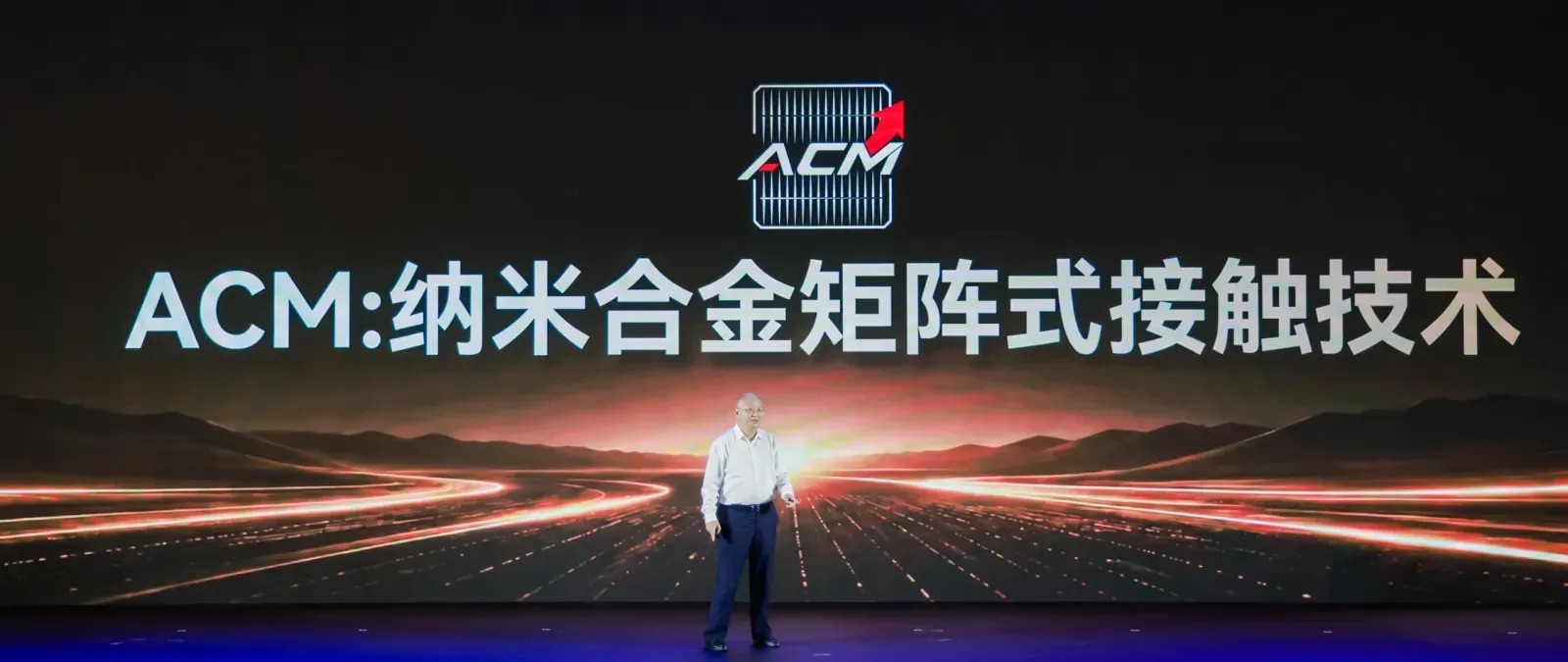
LONGi unveils ACM technology to increase solar cell efficiency and reduce electrical losses
New contact-metal technology reduces conduction line resistance, improves BC cell efficiency, and enhances the long-term reliability of solar panels.
LONGi has unveiled a new technology called Advanced Contact Matrix (ACM), a technology that aims to develop metal contacts and current transmission lines within solar cells. According to available technical information, the technology aims to improve electrical conductivity, reduce internal resistance and losses, improve welding quality, and protect metal lines from oxidation and moisture during the solar panel’s operational life.
25.54%, besides reducing the resistance of the connecting lines by about
50% Compared to some of the delivery solutions used in traditional TOPCon cells.
High Conductivity Nanoalloy
ACM’s technology is based on the development of the metal material used in current collection and transmission lines, through an alloy or fine metal composition that is likely to rely on a silver matrix, with additions of copper or nickel and nano-dimensional particles. Reducing particle size and improving particle distribution helps to enhance the sintering process and create a denser and less porous metal structure, which increases electrical conductivity and reduces resistance compared to traditional silver pastes.
Separation of contact function from current transmission
The basic idea of ACM technology is to separate the function of forming electrical contact with silicon from the function of transmitting current along metal lines.
First: Electrical contact layer
This layer forms precise, localized contact points with the silicon surface. It may rely on a low-melting glass composition, potentially including bismuth oxide, to help penetrate the insulating layers and form low-resistance Omi contact. Reducing the area of direct contact between metal and silicon helps reduce re-union of charge carriers, thereby reducing electrical loss and improving cell voltage and efficiency.
Second: The current transfer layer
The top layer is made up of a highly conductive metal material, whose function is to carry the electric current from the assembly points to the connecting tapes, while reducing serial resistance and reducing voltage drop. By separating the two layers, the chemistry of each layer can be improved according to its function, rather than relying on a single material to carry out contact with silicon and transmit the current at the same time.
Nanocoating to protect against oxidation
The technology also includes a very thin layer of protection covering the metal lines, likely made up of titanium nitride. TiN Or nickel- and phosphorus-based paint. Ni-PThe expected thickness of this layer varies between 10 and 20 nanometers., to act as a barrier to oxygen and moisture, and reduce corrosion or oxidation of metals during plate years in various environmental conditions. This layer can also improve weldability, increase the contact area between lines and connecting tapes, and reduce the likelihood of cold welding or separation of lines and breakage as a result of thermal and mechanical stresses.
ACM Technology Highlights
- Increase the efficiency of the cell. 25.54%.
- Increasing the efficiency of commercial production by 0.2 to 0.3 percentage points.
- Reduce the resistance of connection lines by up to 50%.
- Support solar panels with capacities up to 672 Watt.
- Improve welding quality and increase metal contact space.
- Reduce the risks of oxidation, cold welding and line interruptions.
- High compatibility with back-contact cells BC.
Chemical Weighted Components of ACM Technology
| Component | Weighted chemical composition | Basic Function |
|---|---|---|
| Alloy Transmission Current | Silver matrix with copper or nickel nanoparticles, plus glass material that may contain bismuth oxide | Increased electrical conductivity, reduced porosity, improved sintering and reduced resistance |
| Ome contact layer | Silversilicone contact with local phosphorous or boron inoculation, depending on cell type | Reduce contact resistance and reduce re-union of charge carriers at metal and silicon interface |
| Oxidation resistance layer | Titanium nitride TiN or Ni-P coating with a potential thickness between 10 and 20 nanometers | Prevent the arrival of oxygen and moisture, improve welding, reduce cracking or separation of lines |
A brief comparison of technical characteristics
| Side | ACM Technology Advantage |
|---|---|
| Article | Patented nanoalloy with oxidation-resistant layer |
| Resistance | 50% lower than some traditional TOPCon solutions |
| Increased efficiency | About 0.2 to 0.3 percentage points |
| Capability of the board | Support capacities up to 672 watts |
| Reliability | Increase welding area and reduce oxidation, cold welding and line interruption |
| The most suitable structure | BC back-contact Cells and Direct Linear Welding |
The importance of technology for back-contact cells
ACM technology is particularly suitable for rear contact cells, where all metal electrodes are located at the back of the cell, while the front surface remains free of conduction lines that block part of the light. These cells require a high-precision, low-resistance metal mesh, with high conductivity and welding reliability. ACM may therefore be an important element in improving the performance of BC-based Lungi panels, especially as they move towards larger cells and higher electrical currents.
A new step in metal contact engineering
ACM represents a shift from a focus on increasing the amount of silver or magnifying the connecting lines, to more precise chemical and functional engineering, separating contact formation with silicon, current transmission, and protection from environmental factors. If proven to maintain performance and reliability in large-scale production, the technology may contribute to increasing the efficiency of the panels, reducing silver consumption, and reducing electrical losses, while improving stability throughout the life of the solar system.
Some fine chemical details, such as the type of alloy, the composition of the glass layer, and the protective material and its thickness, are weighted compositions based on the declared technical functions, unless Lungi publishes the complete composition or patent data in detail.