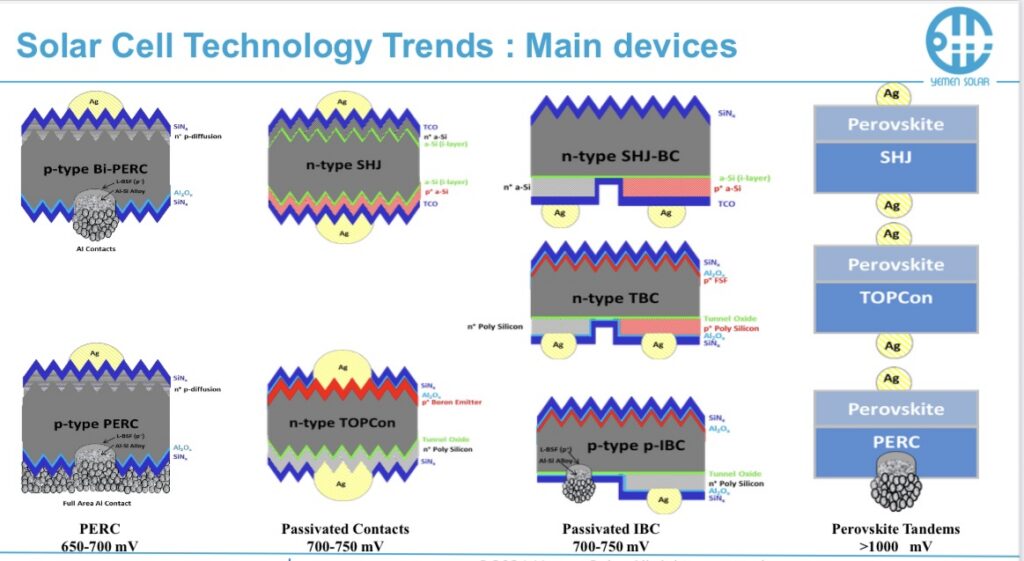
At SNEC 2026 in Shanghai, back-contact (BC) technology emerged as one of the most discussed files within the global solar industry. After years of TOPCon dominating production expansions, the show featured new generations of BC, TBC, HTBC, ABC and HPBC products, amid growing competition among major companies over who will own the next generation of high-efficiency solar cells.
TCL Zhonghuan was one of the most prominent companies that highlighted this technology, confirming that it has more than 1,600 core patents associated with BC technology, within a portfolio of more than 4,700 intellectual property rights. It also revealed the new C3 BC platform, which targets cell efficiency of up to 27.5% and capacity for models exceeding 710 watts with efficiency of more than 26%.
In the commercial products sector, the company showcased a wide range of BC-based models, including up to 800 watts of commercial and industrial rooftops, as well as fully black residential models targeting high-end markets in Europe, Japan and North America.
In contrast, Expo data showed that the competition is not limited to TCL, but also includes companies such as Trina, LONGi Solar and AIKO Solar, which continue to invest heavily in HPBC and ABC technologies as the most efficient route in the long run.
While BC technology has gained significant momentum at the show, a number of Chinese analysts have pointed out that the road to replacing TOPCon is still a long one. While TOPCon has previously managed to displace PERC in a short period of time thanks to its low cost and ease of shifting production lines, BC faces several challenges including high cost, complex manufacturing, intellectual property issues, and low bifacial coefficients compared to the latest generation TOPCon.
The debate at SNEC 2026 no longer revolves around the question of “Will BC succeed?”, but turns to a more realistic question: “In which markets and applications will BC be the best?” While TOPCon focuses on large utility plants thanks to its high bifaciality, BC is turning to high value-added markets such as high-end residential rooftops, BIPV, and projects that require the highest possible efficiency or an advanced aesthetic appearance.
The exhibition also saw the emergence of a new trend in the integration of BC concepts with other technologies such as TBC and HTBC, where Tongwei Solar announced the efficiency of TBC cells to 27.29% and HTBC cells to 27.40%, reflecting the continuation of the efficiency race between the various technical schools.
Based on SNEC 2026, it appears that the next few years will not see a single technology dominating the market, but rather a phase of coexistence between TOPCon, BC and HJT, with the continued development of tandem cells (Tandem) as a long-term candidate for the next generation of solar cells. BC has already succeeded in its most important achievement this year: moving from a specialized technology to one of the main axes of the future of the global PV industry.