
For edge passivation technology to perform, it is not enough to choose the right material, but the sedimentation method must also be able to cover all the details of the edge resulting from the laser cutting, which is full of grooves and microscopic cavities.
That’s why I became a technologist. Atomic Layer Deposition (ALD) The only technology that is practically capable of carrying out this task.
Traditional techniques such as PECVDAlthough they have successfully deposited membranes on flat surfaces, they have a clear weakness in covering the edges and vertical walls, as they depend on deposition in a direct line-of-sight position, leading to areas not covered at the edges of the cut cells.
In contrast, ALD relies on self-limiting surface chemical reactions, in which the material precipitates one atomic layer per cycle, giving it an exceptional ability to completely cover 3D surfaces, even inside micro-cracks resulting from laser cutting.
This is why ALD is described as an investigation. Form-matched coverage (Conformal Coverage), a property that made it the first industrial choice to passivate the edges.
Types of ALD Systems in the Industry
The industry has developed two main types of ALD equipment for quantitative production:
1. ALD tubular (Tube-type ALD)
It is the most widely used system in current production lines.
These systems rely on the deposition of large batches of flakes within a single discharge tube, with reactant gases inserted sequentially.
The majority of systems use:
- Trimethylaluminum (TMA) as an aluminum source.
- Water vapor or ozone as an oxygen source.
The data of manufacturers, such as the company LeadmicroThis system is capable of:
- The regularity of the membrane thickness does not exceed 3%.
- Lifetime for minority cargo carriers up to 760 microsecondsThis is a very high number for TOPCON cells.
Water vapour problem
In traditional systems that use:
TMA + H₂O
Water molecules stick strongly to the surface of silicon, and their survival time on the surface is prolonged.
This leads to a phenomenon known as:
Wrap-around Deposition
Any sedimentation layer wraps around areas not to be covered.
In metal quadrant and multi-finger cell designs, this unwanted deposition may contaminate metal contact areas, increasing contact resistance and adversely affecting electrical performance.
Why did ozone use begin?
To overcome this problem, modern production lines began to adopt systems:
TMA + O₃
Instead of water.
Ozone is characterized by:
- More chemically active.
- Faster to react.
- Easier to control inside the sedimentation chamber.
- Significantly reduces the phenomenon of skirting around the edges.
It thus combines:
- Maintain passivation strength.
- Improved sedimentation accuracy.
- Reduce contamination of metallurgical areas.
Cleaning inside the room itself.
A recent patent indicates that all phases of edge processing can be carried out within the ALD chamber itself.
The process begins by placing the chips inside the chamber at a temperature ranging from:
200–300°C
Ozone is introduced first before any other substance.
During this phase, ozone will:
- Removal of organic residue.
- Remove inorganic impurities.
- oxidation of silicon surface.
- The composition of the ultra-thin SiO2 layer is directly on the surface.
The water vapor then passes to form the hydroxyl groups needed for the reaction.
The usual ALD cycles then begin to alternate between:
- TMA
- H₂O
To form an Al2O3 layer with very high electrical quality.
This method is characterized by integrating cleaning, facade reconstruction, and deposition into a single process, which raises the final efficiency of the cell.
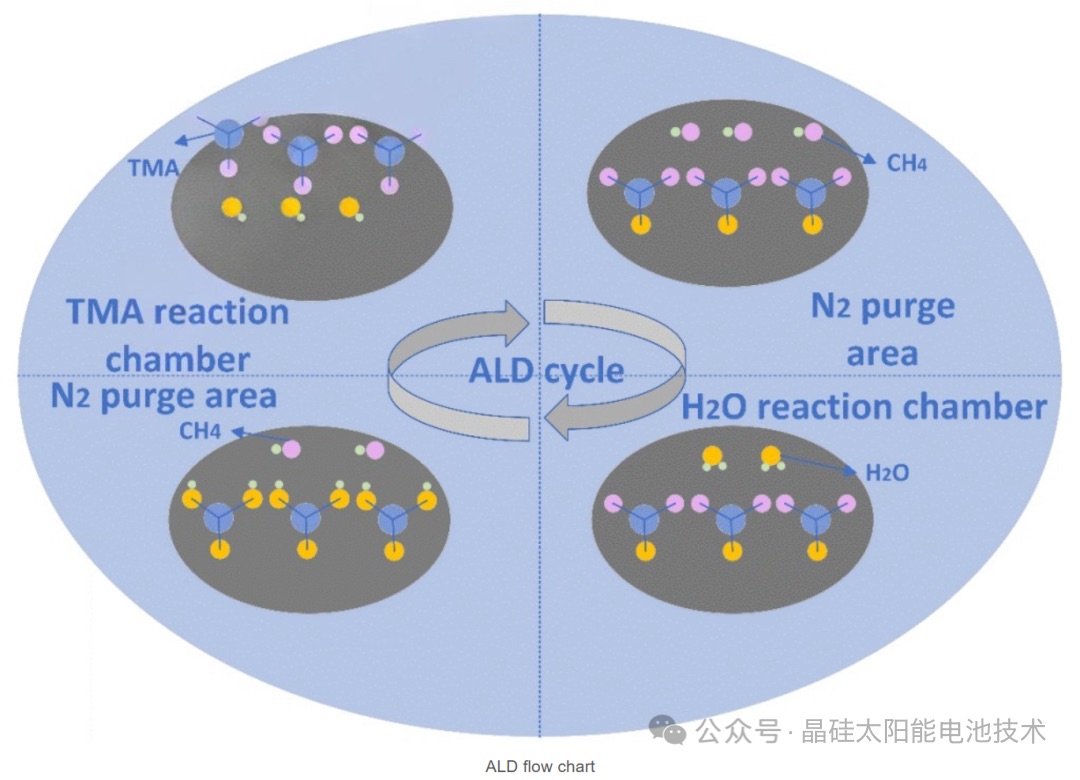
Rotational ALD (Rotating Space ALD – RS-ALD)
Unlike the tubular system, this system does not rely on the sequential introduction of gases into the chamber itself.
Rather, the chamber is divided into several separate areas by fixed barriers, including:
- TMA Region.
- Nitrogen gas area.
- Water Zone.
- Another nitrogen zone.
The chips are placed on a high-speed rotating platform.
As the platform rotates the chips pass sequentially in front of each area.
Thus one atomic deposition cycle is completed with each rotation cycle.
This design eliminates the time lost in the pumping and discharging of gases, which increases productivity significantly.
What have Chinese studies shown?
Several research institutions in China have conducted a detailed study on TOPCon commercial cells measuring:
182 x 91 mm
After partitioning using TLS technique.
The study focused on two main factors:
- Sedimentation temperature.
- Platform rotation speed (RPM).
Effect of temperature
The results showed that the thickness of the Al2O3 layer gradually increases with temperature up to:
200°C
where the thickness reached:
26.3 nm
After 200 sedimentation cycles.
The refractive index was as follows:
1.708
This is the highest number in the study.
But when you raise the temperature to more than:
250°C
Thickness decreased to:
19.4 nm
Although the rate of deposition has increased.
XPS analyses explained that the cause is the start of the decomposition of the absorbed material on the silicon surface, which reduces the density of the membrane.
The study therefore considered that:
200C is the ideal operating point.
Effect of rotational speed
The faster the platform rotates, the lower the time the chip stays inside each interaction area.
The thickness of the membrane decreased from:
26.3 nm at 30 RPM
To:
23.9 nm at 60 RPM
Then to:
18.2 nm at 90 RPM
At the same time, surface roughness has increased significantly.
This is because the high speed of passage does not give the molecules enough time to reach the state of chemical saturation on the surface.
Age of minority cargo carriers
This was the most important indicator.
When:
200C and 30 RPM
Age:
192 microseconds.
And when:
60 RPM
He stayed very close to it:
189.6 microseconds
But after bypassing:
60 RPM
The sharp decline began:
- 90 RPM → 155.6 μs
- 120 RPM → 116.5 μs
The researchers therefore concluded that:
60 RPM is the best balance between passivation quality and industrial productivity.
Why are Laplace and Leadmicro equipment becoming world-leading?
Competition is no longer based solely on theoretical competence, but on the ability to execute these processes at huge production speeds while maintaining quality.
This is why two Chinese companies have clearly emerged:
Laplace
Focused on building an integrated production line that includes:
- Laser cutting.
- Passing edges with ALD.
- Electrical tests.
- Automated sorting.
That is, it offers an integrated system that covers the process from start to finish.
Its data points to research and development investments that have gone beyond:
161 million Chinese yuan during the first half of 2025.
It has also developed a special program to control the edge passivation system based on instant control of:
- Distribution of temperature.
- Flow of gases.
- Motorized arm movement.
Their equipment also includes:
- LPCVD
- PECVD
- Laser Opening of BC Cells
- Low Pressure Oxidation Furnaces
- Boron Spread Furnaces
This makes it an integrated provider of solar cell manufacturing equipment.
The Company LeadmicroI turned to a different philosophy.
Instead of focusing on line integration, I focused on:
- Maximize productivity.
- Reduce the consumption of expensive chemical gases.
- Improved operating stability.
The Platform Edge Passivation 2.0 Its production capacity has reached:
20,000 cells per hour
With the support of all modern designs:
- TOPCon
- BC
- 0BB
- Half-cells
- Thirds
- Quarters
It has also developed an advanced TMA gas flow control system, which significantly reduces waste, as well as a visual monitoring network and sensors on each transmission path, to detect and correct any deviation or risk of breakage of ultra-thin cells within milliseconds.